mars 08, 2013

Painter Momopie for Game Boy


 Painter Momopie
Back to good old game boy. And I play on the Super Game Boy.
Painter Momopie is a puzzle game only released in Japan.


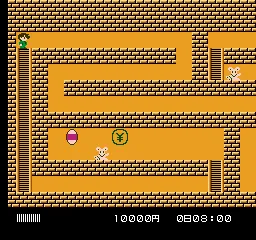
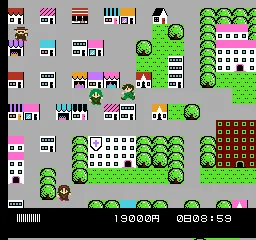
Your job is to paint the floors... While there are enemies that come to attack you.


You have these magic. Active the menu with B, and chose magic with A.Then use the magic pressing A. You need to stand still for the Speed magic. Pyon is a shooting magic you need to shoot some enemies. Sealed I don't know what it does but I think it reflects bullets.

I think the game is sort of cute. It is an early puzzle game (December, 1990) and there isn't much to it though. The king says "Congraturation" and gives you some magic sometimes, but I didn't seem to be able to active those magics. I only ever had the three magics in the picture.

Around level 15, you start playing the same levels again, but they might be called 19 or so. The levels are not exciting. You usually just go into a room and then back.
Music is cute. You have 5 continues. I don't know how many levels there are, I played until 22. Well I think it is a good game for kids, both boys and girls, ages 8-12. I think many of these early puzzle games were like that. I rate it 2 / 5. Quite boring.

mars 07, 2013

Section Z for FDS


I have been playing Section Z for the last couple of games. As you may know, I only play games as long as I enjoy them, and I played this one to the end.

Section Z is a side scrolling shooter with strategy elements. It is hated by some people that don't understand it. They write reviews saying this game "sucks ostrich sized eggs" (google it) and that's one of the nicer things. Luckily there is an excellent description at gamefaqs, http://www.gamefaqs.com/nes/578417-section-z/faqs/44033, on exactly how the game works. After having equiped myself with the knowledge, I ventured out into the Sections. Actually I first tried it without the knowledge and that was hopeless.

Because I enjoyed playing, I just played along and drew my own map instead of following a strategy guide. Also, I think it helps if you try things out for yourself, because you will get a better feeling for the game.

Section-Z Screenshot
Here is an explanation of the unique concept:
* Life Bar: You have the life bar at the top. It says 13/20 in the picture. When you get hit a bullet, lose 1. When you get hit by an enemy, you die and start the section over, and lose 5 points. When you have lost all points, you start over from the last checkpoint.
* Weapons: Where it says "L" in the picture. Pick up power ups to get other weapons. Then select weapon with Left and Right button while you are flying. Press Select to activate the weapon. It will stay activated.
* Exits. At the end of most level, you can travel up or down. Where you will go you won't know. So it is like a labyrinth in a way, and that's why you need to draw a map. But there is no right and wrong way. A longer way is often necessary to get weapon upgrades or fill your life bar. I really appreciate these complex games that aren't linear. And the action is always on, unlike Metroid. It's also goes quite fast to replay most sections.
* Secrets. In some places there are secret doors. If you hit one with your shot, it will display itself as a round opening. If you enter the door, you will either get a room with either extra health or a warp room. Sometimes you need to find this warp room in order to progress. The extra health might also be necessary if you need to "health grind" before a boss or a difficult section.

This concepts are necessary to know if you want to enjoy the game. Nr 1 and 2 I have not seen in any other game, and it would be hard to figure out on your own. Never give up until you have read the manual or FAQ, is my advice.

The save games. The FDS version has a save function, unlike the NES version.
I play on this sexy thing. I would have sold it, but the 1-player controller is messed up on the A button. I now finally replaced the controller, so all games from Section Z on will be played without turbo.

Why I enjoyed the game:
* When you kill a boss or a beam shooting thing, you often unlock a red exit right after a checkpoint. Even if you get a game over, you can just move on.
* The game is always fair. There is often an appropriate weapon for every enemy. No boss is super hard once you figure it out. If you are decent at shooting games, you will spend more time with the labyrinth than beating enemies. If you are very good at shooting games, the game could be too easy. But shmup people might not be good at the strategy aspect so it could even out.
* The labyrinth is also fair. The map I drew covers up to level 39. Levels 40-60 only required a third of that page, so the game isn't Zelda or Metroid long.
* Graphics and Music: Nothing special but alright.
* Even dying can be a relief. If you have come to a section you can't beat with your puny weapon, you can get yourself game over on purpose, so you can restart from the last checkpoint and get a better weapon.
* It isn't linear. Sometimes you may want to jump between two levels over and over to fill up. When you are done, there is often a shortest route you can take to get to the next phase.

I spent around 4 hour the first day to make it to level 40. Then 2 hours the next day to make it to the end boss at level 59. Then another 1-2 hours to understand how to beat the boss, restart, fill up the health to 99, and dying a number of times while doing so.

I think that as far as NES games go (or famicom), this is a game worth trying. It isn't the longest or most advanced game but it is nice, fair, has some original ideas, and no real annoyances once you understand the concept.


I leave the planet. The End.

mars 02, 2013

SD Gundam World: Scramble Wars for FDS


I received a bunch of FDS games recently and one of them was Castlevania. But when I wanted to play it, it was overwritten with SD Gundam. This has happened once before, with the Legend of Zelda. I decided that if a game is good enough that people rewrite Castlevania and Zelda, I should at least try it. No one ever bought my boxed copy so I had actually unlisted it. Here is a new photo I had to take.
Maybe I should relist the game.

I don't generally like strategy games because they often take a long time to learn and then a long time to play. Especially if there is a story mode with 20 or so missions you go on. I remember I played Red Alert to the end when I was younger, but even then I felt the courses took too long.

In SD Gundam World: Scramble Wars (with the full title also including Gachapon Senki) you use robots to fight with. I think in the Super Famicom games they removed that aspect, and the robots do the fighting by themselves. I'll have to try those games some other time. My quest is to play all the good 8-bit games before I move on to the 16 bit games, and then later other consoles.

I was pleasantly surprised by SD Gundam World: Scramble Wars . There is very little information on how to play the games. I just picked it up and start playing. There is no story mode I can see, you just select one out of 10 missions. I didn't understand the menu after that, maybe you select a difficulty level there. Once playing, I had to restart twice until I understood the exact strategy, but after that I played a good 4 hours until I beat the first course.  I think it was straight forward and not too difficult.

There are some loading time and "thinking" time for the computer AI, but I will say that in a strategy game it doesn't matter that much because you can spend your time thinking what you'll do next. Or you can grab a beer, or just watch the computer play.

My strategywiki "hero" who has written so many helpful articles is negative about this game. (http://strategywiki.org/wiki/SD_Gundam_World_Gachapon_Senshi_-_Scramble_Wars) What's the matter punk, emulator save states didn't help you? Well I had a fun with it. I spend most of the night. You can actually save your progress by just pressing Start (or is it select) in the map mode and press "Yes". Then it gets saved to the disk and you select Continue next time. But I prefer to play in one sitting.


Well alright. You play on a map screen. A part of it will look like these pictures.

You have a home base were you build your robots. The opponent also has a base. The goal of the game is to take the opponent's base. From the home base you select which robot to build. Its name, cost and move stats will be displayed in English or in numbers.

On the map are a number of cities or small bases that you can take. They will increase your income. Income is where it says "IC" in the bottom right. "CT" is how much Capital you currently have.

The manual has explanations on all robots in Japanese I don't understand. But the important stats are: Health, and Moves they have. Weapon is also important but generally if it is expensive it has good weapons.

The idea is that you move your robots around on the screen. I won't bother with the details because you'll understand them quickly. You might want to know that you can end your turn early by pressing A+B.

When your robot encounters an opponent's robot, the screen with become a battle screen.
What battle screen depends on the terrain you are in. This one is underwater. As you can see, the W-Base robot has a lot more health, and it also has a missile to shoot with.  The battles may seem difficult at first, but I figured out a little trick in the space battles: stay at the bottom and just shoot. The computer is quite aggressive so it is often better to wait for him to attack and just shoot him down.

I learnt that a robot get his health restored when he goes to one of the bases. That is an important strategy element.

The cost of the robots are very different. The most expensive is W-Base that costs 8000 "money". The DOM is the third cheapest unit, costing only 500 money. The W-Base is however not a great fighter because he has no short range weapon, so I would prefer to build the second most expensive units: Psyco Gundam or ZZ-Gundam. They cost 4500 money. Early on in the game you don't have so much money to spend and it may be more useful to build cheaper units that are still powerful, such as the Bound-Dog for 2500 or the Gundam for 1500.

The more bases you take, the more money you'll make each round, which will enable you to buy better robots. That's all there is to it. In the end you'll fight the opponents base keeper, and then you win.


The FDS game also has a two player mode. This was removed on the Game Boy Advance version.

februari 25, 2013

Hi Saturn Navi arrived


It is the most expensive retro thing I've bought.  I am excited about it but also a bit disappointed. It is smaller than I thought and has a flat top. I think the skeleton This Is Cool looks cooler. I also didn't get an LCD screen with it. I did get some other accessories, such as straps and the GPS thing. But without the LCD screen there isn't much special about it and not worth its price.

I took a chance and bought it as "junk" and I am still happy I did, because these things are hard to find and very expensive. The console is in great condition, even if the box looks like it has been beaten up.

Supposedly "a couple of thousands" copies were sold. I am always sceptical about those claims. You find "fewer than 2000" mentioned and taken as a truth. In reality, the numbers aren't known. "Someone" claimed it... Based on what? Stop believing in whatever anonymous people write on web forums...

But still I think it is more fun to have a items that are uncommon because they didn't sell well. This console was too expensive at the time, 3x the price of a normal Saturn. Items that are released as dedicated "limited editions" are often collectibles and often they can be found in 10 000 unopened copies, and that takes away the fun I think. At least the Hi Saturn Navi was made to be an extreme product for high end users to be used, and not to put in a shelf to collect dust.

It is unlikely anyone would give me what I paid for it, so I think I'll keep it. It can play CD+G -- karaoke discs. Might be useful some day.

Update: I put it up for sale: http://www.tradera.com/hi-saturn-navi-system-auktion_302266_176318275

Kieta Princess and Fuuun Shourinken for FDS

While I am trying out my FDS games, I came to these two games.


Pretty depressing in my opinion. After playing I lowered their prices to 49 SEK (8$?).

Fuuun Shaolin Kyo or Shourinken is an early fighting game. Have you played Yie Ar Kung Fu or Urban Champion? Urban Champion was made by Nintendo and may be their worst game. Fighting games in those days really were fighting games and not what they became later. Controls are stiff because they are real.  But unfortunately all early fighting games are terribly boring. To be fair, Yie Ar Kung Fu has a certain charm to it. The speach they make when hitting "ya ya", "huh huh" gives it a comedic touch. The later Karateka for NES/Famicom is playable too.

Amazingly a guy on strategywiki has written pages on this Fuuun game. What a waste of bytes?
Attacks in this game are initiated by a direction, or a direction button combination. The direction that you input is relative to the direction that you are facing. Note that your character will not automatically turn around if the opponent is behind you. You must instruct your fighter to do so by pressing the appropriate direction. Refer to the chart below for a full listing.  -- http://strategywiki.org/wiki/Fuuun_Shourinken
Hardcoregaming said that the game is quite good. That's the first time a page is more positive than I am. ( http://www.hardcoregaming101.net/fighters/fighters4.htm )

After you die two times in Fuuun Shourinken you are game over. But on the first level you are game over if you die once. That's boring...

For the other game, Kieta Princess is a game so simple that I must say it is a crappy game, for real.

I tooke these pics from http://www.mobygames.com/game/nes/kieta-princess
Kieta Princess NES Starting out
 You start off in this simple puzzle like level. I honestly think a 5 year old could play this.

Kieta Princess NES This town is pretty large Then you come to the town. You walk around to collect clues. Strategywki has a page on this game too...
You must visit five different towns and collect information. Neary every house and building can be entered, which was unique for its time. The game also features a high degree of freedom, allowing you to visit restaurants for a bite, or a Dojo to train, or to hunt for vegetation to sell for money, while you are looking for the princess. The degree of difficult throughout the game is considered quite high, with very few hints to help you out, while other hints are misleading. -- http://strategywiki.org/wiki/Kieta_Princess
Being able to walk into all the houses and have freedom to interact with anyone reminded me of Pizza Tycoon and other Tycoon games on the PC. Except those game was fun. And all the text here is in Japanese, so it is impossible for most of us to make progress.

Maybe it is just that the freedom aspect of gameplay has developed so much in the last 15 years and these early games are too outdated. To be fair, this game is not the worst NES game. I think the developers had enough interesting ideas to create a playable game. But I am now confident about one thing: a lot of crappy famicom games involve someone walking around in a town.  

Kieta Princess game was sold with a notepad and a cassette tape you could listen for clues. I do think that box looks cool. I'll try to pick one up from Japan.

I didn't know there were so many bad FDS games. Bad memories of Chatran and Dirty Pair appear... I still tell people that the FDS is worth it just for the original classic games such as Zelda, Metroid, Kid Icarus, SMB2, Doki Doki Panic, Castlevania, and a couple of other titles. I do think so.

februari 24, 2013

Zanac (AI) for FDS


I never sold this game, but it seemed like a good game to me. So yesterday I tried it out. My main issue with shmups is that they often have limited continues. I only play limited continue games if they are so much fun that I don't mind restarting.

The NES version of Zanac has a start menu with a continue option. The FDS version doesn't have that, but luckily I have the manual and it says that Select+Start continues the game. This can be pressed as soon as the "Game Over" text is displayed. If you forget, you can press it at the start screen too. Starting with Level 5 the disk will then then re-read, but it only takes a few seconds in this game, maybe 5 seconds.

Zanac Screenshot

Zanac can be intense at times. I "cheated" with a turbo controller, but that is because I have the twin famicom with turbo and the turbo controller is the only controller I have. I don't think turbo is necessary though, because you can often just hold down the button.

Even if there is a lot of bullets on screen there are no slowdowns and I didn't notice any serious flicker either. I am impressed at how much the shmups matured from earlier games such as Xevious and Argus.

My goal was to play past level 4, and I made it all the way to level 11. On level 11 and 12, the last level, there are no continues. If you are game over, you continue at level 10. In the NES version there is a cheat around this, something with "Press Up, Down on 2 player controller, then Continue". I wasn't able to try this on the FDS version. Another NES cheat, the level select cheat, doesn't work on the FDS anyways (press Reset 13 times, etc).

The game has two kinds of power ups. The first one is in the three-boxes you see above. One of the boxes holds a shoot-powerup.

The other powerups is for the A attack. The A button has the alternative attack. There are 8 different alternative attacks and you can only have one at the time. It gets upgraded if you take another powerup with the same number. In the picture above, the ship has alternative attack #2, which is a front shield. Not one of the most powerful items but useful at times. I prefered number #3, which is an item that circulates your ship and is useful for both attack and defence. It takes away incoming bullets and kills enemies it touches.

The special attack you start with is #0, and that is quite good too because you can shoot in any direction. 

Here is a video from nesguide of Area 1. Area 1 is not that intense, but I think it is the longest one so it can be used for practice. A comment is that is looks like Guardian Legend, and it is because the games were made by the same developer. They also made Gun Nac.

_

The little extra feature of Zanac is that gameplay can get harder or simpler, depending on how you play. There is no guide on exactly how it works. It is claimed that shooting a lot will increase difficulty, but you will have to shoot enemies and stop shooting isn't an option. I noticed that with the shield powerup I got some tougher enemies at one stage. With a good powerups I think it is best to shoot as many enemies as possible so that you will get extra lives.

I enjoyed the strategy elements of the game. You have chose the secondary weapon you have with some care because they are so different for attack and defence. Because the incoming enemies are different in between plays it makes the game feel more alive. That's what the AI of Zanac stands for.

A gamefaqs FAQ gave useful "advice" on this game in the style of "So simple level. Shoot enemies and shoot the boss". But actually there is a lot more that can be said about strategy. What weapon to use, how to best kill the enemies, and how to avoid making the game harder.

The first couple of levels took me between 10-15 minutes. Level 9 got harder and took 1:15. Level 10 took 45 minutes. But because of no continues on level 11 I had to quit for the night.

I think I did well considering my limited shmup experience. It is because this game is fun and fair. Unlike Salamander / Life Force -- I don't know how an adult can bother playing such an unfair game for the first time. Occasionally you will read comments such as "Oh, Salamander isn't really that hard", "Oh, Gradius is quite simple". But it is relative to how much time you have. If I would have spent months of my childhood on Gradius I would also beat it easily, but I am older and can only give it a couple of hours (and I made it to just before the Brain). ;) Playing shmups is supposedly better when you are young and have lightning reflexes.

Most shmups are too hard for the occasional gamer. That is why they often didn't sell very well and the genre is a small niche compared to for example Dragon Quest.


This was the last level I reached. Area 11. 

februari 23, 2013

Boktai 2: Solar Boy Django for GBA

 Boktai 2: Solar Boy Django (EU)

About two years ago, before I started with Japanese games, I played Boktai 2 for GBA. I played the European version that has English text.

Action/RPGs or RPGs isn't my favorite type of game. They take too long, and after a while I forget the story. It also takes time to learn how to equip spells and everything else with the gameplay. And I also think the games are just too long for me...

None the less, I wanted to try out this game for the interesting feature of solar detection. The cart has a little solar detector, similar to a calculator. It will detect how strong the sunlight is. You need the sunlight to charge the energy that is used for magic.

 ScreenshotI played it during the summer two years ago. A nice side effect is that I got a lot of sun that summer. But then there was a week or two of cloudy weather and I had to stop playing and then I forgot about the game. You can play when it is cloudy but the sun is a lot weaker making it longer to recharge. If it is really cloudy you can't play and obviously you only play during the day. Technically you can play, but you can't recharge your character's energy. And some puzzle require the sun energy.

One of few action/rpgs I have played is Diablo, so I think I can say this game is like Diablo. Or should I say Landstalker? You go around slashing your enemies. You equip spells and talk to people. Every now and then there is a puzzle you need to solve. Sometimes the puzzle makes use of the sun in clever ways. For example, sometimes the sun will shine through a window in a house your character is inside. You may need to cover the detector with your hand to have items move around on the screen.

The reason I picked out the game today is because I bought a UV light for retrobrighting a while ago. It is 15W low energy which is maybe 50W "normal" energy. It brings up the Sun energy a couple of levels, not as much as I thought actually. I suppose stronger UV light would be good for my retrobrighting. Unfortunately my eyes are sensitive to this UV light for some reason.

Well, if you enjoy these kind of games I think it is well worth trying, but unless you have a UV lamp you need to have a period of sunlight.