Visar inlägg med etikett puzzle games. Visa alla inlägg

mars 16, 2018

Vad är Puyo Puyo och varför är det så populärt i Japan?

Vid första anblick kanske det bara ser ut som något färgglatt pusselspel som försöker efterlikna Columns och Tetris. Men det finns fler bakomliggande faktorer till varför denna spelserie vuxit sig så stor.

Själva spelmekaniken går ut på att kombinera färgerna, precis som i spel så som Columns och Dr. Mario. Man får en slumpvis utvald bit av två ihopsatta "Puyos" att snurra på tills du bestämt dig för var du ska placera dem. När fyra eller fler puyos av samma färg angränsar till varandra lodrätt eller vågrätt (inte diagonalt) så spricker alla i den gruppen och försvinner. Skillnaden är att inga Puyos är statiska, utan att gravitationen alltid tar över och de sjunker nedåt om det inte finns mark eller någon annan Puyo under dem, även när en färgmatchning inte är gjord.


Det första Puyo-spelet som gjordes var 1991 till MSX och FDS. Det är utvecklat av Compile och innehåller karaktärer från deras egna rollspelsserie Madou Monogatari. De bitar man spelar med i alla Puyo-spel, även kallade "Puyos", är Compile's motsvarighet till Dragon Quest's "Slime", eller Final Fantasy's "Flan", d.v.s. en av de första basic-fienderna man möter i ett typiskt japanskt rollspel. Puyo-spelen är alltså en spinoff som haft större genomslagskraft än ursprunget.

 Bildresultat för puyo puyo MD screenshots

Compile började sedan att samarbeta med Sega. Där fokuserade man mer på VS. play än Single Play. Spelar man 2 spelare mot varandra attackerar man varandra med "skräp"-puyos som uppstår när man gör kombos/chains. Bilden nedan visar några exempel på strategier man kan använda sig utav.


Sedan dess har spelen fått en uppsjö olika uppföljare. Uppföljarnas titlar kan tyckas märkliga för de som inte kan japanska, men faktum är att de är ordvitsar baserade på hur siffrorna uttalas. Engelskans "two" skrivs som "Tsuu" i Japan, "Sun" (sol) är en hint till den japanska siffran 3 (San) och på fjärde spelet har man lagt till "~n" i slutet på ordet Puyo för att på så sätt skapa siffran 4 (Yon) osv.

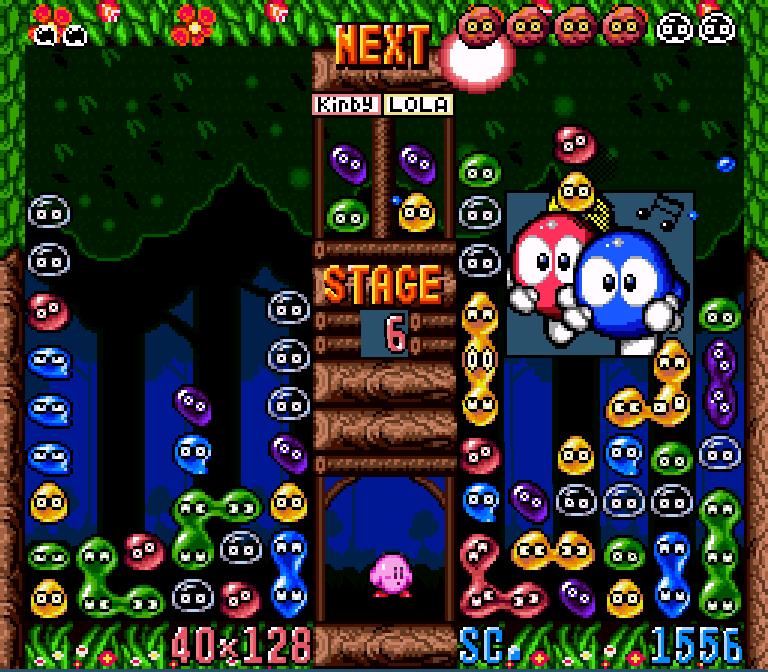
mean bean machine Kirby's Ghost Trap
Då RPG-serien Madou Monogatari inte släpptes utanför Japan är det lätt att förstå varför vi här i väst inte känner igen karaktärerna från Puyo Puyo. De enda västerländska spelen som kom ut var Dr Robotnik's Mean Bean Machine till Sega Megadrive och Kirby's Ghost Trap till Super Nintendo, som var omgjorda versioner av Puyo Puyo med utbytta karaktärer. Det var först på 2000-talet, när de nya spelen till Game Boy Advance, Gamecube osv. döptes om till Puyo Pop, som vi i Europa och USA fick ta del av utbudet.

 puyo pop fever


januari 20, 2015

Famicom friday, 5 games

We've had a little more free time recently so Fredrik could take up Famicom Friday.
There are some games that have been laying around for a while that he's been curious about.
All of the games are for sale at our shop, you can reach the items through the title links below.


First the puzzle game Ochin ni Toshi Puzzle Tonjan. A pretty uncommon game, and puzzle games can sometimes be surprisingly fun. However, the game felt very simplistic so it was probably made for kids.


Then he tried Super Chinese 2.


There are three Super Chinese games for Famicom. There are also three games on Game Boy ("Super Chinese Land") and three for Super Famicom ("Super Chinese World). We have a gameplay video of the first game on Game Boy, too.

The first game on Famicom and the first game on Game Boy are full action games, and they seem to be completely in English. The rest of the games have some RPG elements. A fun thing with these games is that they fully support 2 player co-op mode.

But this Famicom game turned out to be pretty hard to play if you don't know Japanese... I suppose it is playable with a guide, but it would take a very long time to get into it. So Fredrik didn't play for long, since he wouldn't understand the story anyway ...

So he went on to some Namco games instead. Namco made many very enjoyable games based on their arcade games and you know you will always get some decent gameplay, even if the games may lack depth.


Dragon Ninja was more fun than expected. It is also called Bad Dudes outside of Japan. The initial feeling is that the movement is stuttering and unresponsive, but you will get used to it very quickly. It has a great "Double Dragon" feeling to it, and the fighting gives satisfaction. A charming and surprising little addition is the "I'm bad" speech when you defeat a boss. The game seems to have unlimited continues so Fredrik kept playing for several stages.


Quinty is a simplistic but perfectly playable little action game. It is also known as Mendel Palace in the US. Like with many Namco games, the Famicom games seems to be entirely in English. It also has unlimited continues. We recommend playing in 2-player mode. You won't get blown away by it, but it's always nice with co-op mode.


Lastly, he played Burger Time. He tried it before but never made it very far. So this time he decided to give it some more time.

Typical for these arcade made games is that they were made to NOT be beatable... It is a difficult game if you don't learn the enemies' movements, much like in Pac-Man. They often don't move directly towards you, but move right and left instead. After a couple of tries, he made it to stage 3. Must have been tough, though, seeing as he had nightmares about the game that night!

maj 06, 2014

Othello World, Super Famicom


During the weekend, I played several hours of Othello World.


For this blog post, I will call the game Othello. In the US, the game is known as Reversi. Othello is a trademark name that was developed in Japan in 1971 based on the English game Reversi, developed around 1880. For more information, see http://en.wikipedia.org/wiki/Reversi.

I enjoy to play Othello against computers and I can usually beat the simpler ones, but not this one. As one reviewer on gamefaqs said, this is a hard Othello game.

There are five world. Eventually I did beat Sky World after I found a strategy I could use, but after Sky World there is the Sky Caslte world that is REALLY hard. I may have had a won game at some time, but in the endgame you have to be a master of calculation and that is very hard against the perfectly calculating computer.

In order to beat Sky World, I had to put some time into actually studying Othello. I read this strategy guide: http://www.samsoft.org.uk/reversi/strategy.htm
and "Othello lesson" on youtube (lesson 2 here: https://www.youtube.com/watch?v=at0g9zibQZY

These strategies didn't work well against the computer, however, so I played  different against it. I played the opposite of what the guides suggested, but I think I did alright. One needs to realize that I am not an expert player and can't remember long lines of opening play or do long lines of precise calculation.

It was an anti-computer strategy. My plan was to take possession of three of the four sides, and give one of the sides to the computer. Most importantly, I take the side to the opposite of his side. Then I would allow him to give me disks and try not to get outside of the inner 16 squares.

Since I have all sides but one, I will have the last move on any row or column and slowly he will run out of good moves. It is useful here to have a few waiting moves. Because I have given him one of the sides, once he runs out of good moves, he will have to move on that side to give me the corner, and a theoretically won game (just needs some hard calculations). 

There videos might be boring for the average person, but I think that someone who is really interested in Othello or Othello World might find them interesting.

Here is how i defeated the fairy


And here is grim reaper. He was harder than the fairy.

On Sky Zone, you are allowed to get three hints. Just press start, and the computer will tell you how to move. This is useful for the endgame. Unfortunately you con't have this on the Sky Castle and I didn't have much chance without my hints.

There doesn't seem to be any password online for this game so here are passwords for Sky World and to Sky Castle. To enter the password, select Continue from the start screen, then you enter your name in 4 letters (press Select to change to Latin letters), and after that you will be able to enter the password. The password screen allows many letters, but only enter the ones you need.

Here is the password for Sky Zone.

And here for Sky Castle.

There isn't much else to say. It is Othello, and it is hard.

december 07, 2013

Famicom Friday: Fuzzical Fighter and Palamedes II


Yesterday I had myself a Famicom Friday, with some games that have not been sold for a while.


Palamedes II.
125 SEK

I played this game for about an hour. At first it is almost as annoying as Puyo Puyo but there are two good things compared with Puyo Puyo. First, the matches can be over really fast which reduces the annoyance. Secondly, I won sometimes.
The game has some randomness to it, so one is likely to win after a while.

_
The gameplay seems complicated but it isn't. You have the die [sv not: "die" är singularform av "dice"] at the top with a number. Your have to place your dice that will make a poker-like number. The best combination is a straight, such as 6-5-4-3. Second best is four of a kind. Also good is three of a kind, or two of two different sorts. When you get some good combination, you will remove 1-4 rows from your screen, and the opponent will get 1-4 rows added. That's the puyo puyo aspect.

The tricky thing is that you can only place a die that has the same or acjacent number as the die on the table. So if the die on the table has 5, you can place 4,5 or 6. Say you place a 4, then the die on the table will change to a 4. This also effects what the opponent can place.
I think the video explains the rest of the gameplay.

The game was fun for a while. The main annoyance is that the die on the table is hard to see when you look at your own board. They should have put it in the middle, and maybe have a sound indicating what it changes to. The second annoyance is that the game feels random. In one moment you are almost dead, and the next your screen is empty and the opponent is almost dead.


The third game I played was Fuzzical Fighter.
195 SEK

Strange that this game hasn't been sold, but I was happy because I enjoyed it very much. I played it for 3 hours. Not only is it uncommon but also a great game.

Sometimes I think many people don't have very good taste, because I keep on getting requests for games like Trip World, that I don't even think is fun, but I now have a loose copy for sale for 795 SEK (125$). That is the lower end of the current price on eBay. Fuzzical Fighter is unsold for 195 SEK. Oh well.
_

At first Fuzzical Fighter may be confusing because you start in this Dragon Quest view and might think "oh no, not another weird japanese RPG". But actually the RPG mode is insignificant and easy to figure out. To prove my point, you get passwords that consists of FOUR NUMBERS and is the same for a level no matter how you upgraded. So it isn't an upgrade-heavy game.

It also starts off slow and easy and may seem boring. But there are 8 levels and they get harder and faster.

You get gold when you shoot enemies and you use it to buy stuff in the shop. In the shop with an ship sign you can upgrade Shoot (シュート ? I don't know), Shield (シールド) or Engine (エンジン). The katakana is literally the English word phonetically. Learning some basic katanaka is actually not that hard. I recommend practice on: http://www.realkana.com/

In the other shop you can buy items, literally アイテム.
You use the Item by pressing Select during gameplay. I know one item will take you back to the last castle you won. One upgrade is "Add Power" (パワー means power) to add HP, and one is "Add Magic" (マジック means magic) to add more Magic points.

The magic that is 16 MP will also take you back to the last castle. This is useful if you are almost dead. Use magic buy equiping it, and press the A button.

To equip your ship, simply press Start when playing and select your upgrades.

A special thing about the game is the Fuzzical mode. This is an autopilot of sorts that will avoid obstacles. I think it is useful on later stages when the screen scrolls fast and there is a ceiling and ground that show up. I actually had the Fuzzical mode on in the video because it made it more fun to play. It feels weird at first but is strangely playable. Easier than when I tried Darius II last week with my not-too-functional Mega Drive controller.

The graphics is nice and the music is well made.
To buy upgrades you sometimes have to "level grind", meaning you play a bit of a level until your HP is low, then you use a magic to go back to base, buy an upgrade, restore health, and restart the level. You restore your health by going to Inn, select the top menu item, and then chose the top item that is cheap and will restore your HP and MP.
I didn't mind grindning because I thought the game was fun to play.

If you are one of the people who read my blog posts regularly, you may know that I enjoy action games with a strategy element. That  is so that my brain will do some work and not just my reflexes, and to keep my from falling asleep by repetitive gameplay.

It is also nice with a shooter where you can keep on trying. Keep on collecting gold and buy upgrades instead of getting game over. It doesn't feel super hard either, which is nice for someone like me who is not a mad-skillz button mashing shmupper (who only plays with a custom made Seimitsu part stick).

I show a video from early gameplay only. It gets more fun later on.

And as bonus, a few days ago I also played some more Super Mario Kart ghost valley 1, to show I could beat the time I mentioned in my recent Mega Drive blog post.
_

And I made another Goemon video! Now on super famicom: Gokujou Parodius. Wow, some of my favorite games Twinbee, Gradius and Goemon all in one, what a combination! But I feel that parodius is more of a joke than a game. :) I don't play it seriously.

_

november 19, 2013

Currently playing: Mario's Super Picross on SFC

Mario no Super Picross (JP)
Last week I have spent more time than I should playing Mario's Super Picross.
I don't actually play many video games, even though I sell them. Mostly I prefer to relax after work. But this is a relaxing and de-stressing game.

Who ever had the game before me must also have thought so, because in the savegame he solved all 300 puzzles. That probably takes at least 100h in my estimation. The early puzzles are simple but later puzzles take almost all the 30 minutes and may require several tries. Last copy I tested had something like 280 solved puzzles... Yes, addictive game, and maybe not that well known.

I'll borrow someone elses video because I already uploaded a game boy picross video.
__
So it is pretty simple to figure out. a 0 means there are 0 black blocks on that row or column. If it says for example "2 2" it means that are two black blocks next to eachother, then unknown emply blocks, then another two black blocks next to eachother.

There are some tricks to figure out where the black blocks are. For example, if a row has max 15 blocks and there are 9 connected blocks on that row, you know there will always be a couple of blocks in the middle.

The difference with this SFC game from the GB games is the Wario mode. In Wario mode you don't get penalized for placing in the wrong square and the timer goes up instead of down. That means you can't lose a level, but the levels also seem more difficult to solve.
__

I wish the music of the games were better. It isn't bad but I think it could be nicer to listen to, and more variation would be good too. But I still play it.

I read the game was the first Japan exclusive game to be released on the European Virtual Console. I play it on super famicom hardware, obviously.

november 11, 2013

O-chan no Oekaki Logic, Sega Saturn

Article by Kristin

This game works exactly like Mario Picross, the only difference is that our well-known plumber is exchanged for Sunsofts characters from the Hebereke series. It's a puzzle game where you try to figure out a pattern based on numbers on the side of the board. If you are unfamiliar to the Mario Picross series, you can read about it in our previous blog entry from last year: http://japanspel.blogspot.se/2012/09/mario-picross.html. Also, now that we have a video recorder, here is a video that Fredrik made recently of the Game Boy version of Mario Picross:


O-chan, the cute cat-girl (who is changed into the Lizard boy Freeon-Leon in the NES game Ufouria), is the main character of O-chan no Oekaki Logic, in comparison to all other Hebereke games where Hebe (or Bop-Louie in Ufouria) acts as the main character. The games has been released on many platforms: Sega Saturn, Sony Playstation, Super Famicom and Wonderswan. The Playstation even got two sequels, logically called O-Chan no Oekaki Logic 2 and O-Chan no Oekaki Logic 3.

I don't know much about the differences between all these versions of the game because there isn't much information about them on the internet. But we were able to try the Saturn version and uploaded a video about it on our YouTube channel:

_

We recently sold the Sega Saturn version on Tradera, the auction ended at 52 SEK which is about 5 euros. You might still be able to see the auction here. None of these games are very common but they are also not very expensive, so they could be worth checking out if you like challenging puzzle games and have grown tired of Sudoku. We hope to get more copies of this game in the future. Next time, maybe even for another console.

maj 31, 2013

Loopz for game boy


I recieved Loopz recently. Not a common game, but pretty cheap when you find it, because few people play it.


It was released on other consoles too, such as NES and Amiga. In was released on the Game Boy in 1991, in both Europe, the US and Japan.

Loopz is a "hardcore puzzle" game that might suit engineers and people who spend hours trying to solve Rubik's Cube on their own (without success).

The point of the game is to build "loops", pipes that are connected to themselves. At every turn you get a randomly generated pipe shape and have to place it somewhere. A timer starts counting. You can fail three times, then you are game over.

Well, there are some strategically interesting things about the game. For example, I wasn't too successful with building my "mini loops" in the picture above. If you build like that, you will always be lacking in those small pieces. I would like to mention that I did get better at placing the pieces after playing for a while. Also, I probably shouldn't call them pipes, but the game has the same idea as Pipe Dream.

It seems that as you play a while, the pipe shapes get more difficult, such as the difficult to place Z shape. There is a strategy suggestion at http://www.gamefaqs.com/gameboy/585791-loopz/faqs/36001 .

The game has modes A , B and C. Mode A is unlimited play to get a high score. In play B you get a bonus after doing a loop worth 1500 points, but I haven't been able to do that and see what happened. Mode C is more of a memory mode where pipes are removed and you put them back.

The game actually got some decent reviews on all the consoles it was released on. Such as this one for the Amiga:

Creating perfect loops seems a promising concept, but its implementation is flawed. The random piece selection can be frustrating as it doesn't allow you to plan ahead (a Tetris-style 'next piece' indicator would have been helpful). And when you've got a nearly full screen, you often get several large pieces in succession, losing you several lives in one go. Apart from these niggles though, Loopz is quite fun – especially in the competitive two-player mode which involves stealing and sabotage! The different game types provide variety; the skill levels challenge, though there are no real graphical rewards. Let's hope Audiogenic do an improved sequel.
Considering these flaws, and that the high score resets when you turn the game off, it is the bare minimum of a game in my opinion. It makes almost as little sense as drawing something randomly on a piece of paper and giving yourself a score on it.


I rate this game 2/5. I don't know, but I think that by now most people can easily find lots and lots of puzzle games that have more to offer. As an iPhone app or on the internet somewhere. I never could see the point of the arcade style games that just kept on going until you got a game over. Games such as Pac-Man and Donkey Kong that had no end and weren't intented to be beatable. Fun for a little while maybe, but pointless ??

maj 10, 2013

Prince of Persia for Game Boy

Prince Of Persia (EU) Prince of Persia (JP)
I got a new game recently. Prince of Persia, my Japanese GB cart nr 536. It is uncommon in the Japanese version.

The controls play fine, the game idea is what it should be, the graphics is excellent, and there is nothing to complain about. From what I could find on the internet, the GB version is a pretty flawless version of this classic platforming game. I played a GBA version (Sands of Time?) a while ago, and I thought the GBA game had lost the charm... It was complicated with different powerups and weapons, stopping time and so on.

The original version that was released on every major console and computer is very simplistic. You have 1 hour of time to complete the game. If you die, you restart the level with the same time you died with. You get a password after each level so you can start the level with the time you had when you first entered the level.


It looks better with Super Game Boy but I took this image from gamefaqs.

The game is more like a puzzle than a platforming game. You need to time your jumps and be careful so you don't step into something that kills you. For example you have to step slowly towards the edge, turn around, press down to jump down. And so on. It has its charm, but it isn't much action and you might feel constricted if you aren't used to it.

Most of the game is spent running, jumping, and sometimes fencing. The fencing is also more like puzzle than action.

Not only do you have to complete the level, you probably want to replay it until you can do it in a short time. A good game for the perfectionist, not for a person who wants to blow up stuff and have constant action...

Update 2013-05-12: I played a couple more hours yesterday, and couldn't even beat level 3 (I came close one time!). There are 14 levels. You can expect the game to take a long time, at least if you haven't played Prince of Persia before.

If this was my first Game Boy game, I would have played it for hours and hours. I would have been very happy with it. It isn't too difficult, and most people should be able to beat it, but it will take several hours to master all the traps. I give it 4/5.

mars 17, 2013

Stop That Roach! (Hoi Hoi Game Boy Ban) for Game Boy


Hoi Hoi - Game Boy Ban (JP)Stop That Roach! (US) 
Released in the US and in Japan in 1994.

The boxed copy of this game is apparantly quite expensive. Even the Japanese version.
I sold my boxed copy for only 75 SEK (10$) a couple of months ago. I had two, so I didn't think it was rare... I had actually forgotten about it until I made a google search and found my own image.
I had it up for sale for a year. I would have taken a better picture today.

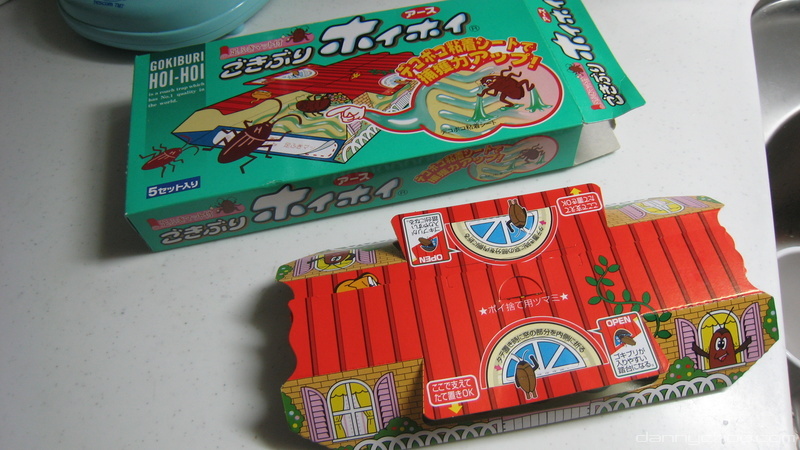
Anyways, I decided to try the game out. There are some vids and pics of the game, but I couldn't find any past level 8. Only at level 9 you start to place "hoi-hoi" , a Japanese trap for cockroaches.

(pic from http://www.flickr.com/photos/dannychoo/2697995445/sizes/o/ )
A video of the first levels.

The challenge is that your actions will affect nearby roaches, depending on where you stand and what direction you face. And you only have five moves.


Here on level 11, I will place the trap as in the picture, then move left, scream for the roach to move, he will move right, I will go right and scream again.
And he will fall into the trap.

It is more complicated than one might think, and it gets more complicated later. In total, there are 100 levels.

I have never played one of these puzzle games all the way to the end because it takes such a long time. I guess that it will take at least 10-20 hours to complete the game if you haven't played it before.  Probably longer.  The good news is that you seem to always have 5 moves, so in theory you could solve every level in less than a minute.

This is a 100% puzzle game with no action moments involved. Play until you find the solution. It puts it in the same category as games like Kwirk, Boxxle, Mario's Picross, the simplistic Q-Billion, and also Lazlo's Leap that I have reviewed earlier. I also know there are other games but they don't stick in my memory.

For example, I have played very many levels of the action/puzzle game Solomon's Club for Game Boy, but I can't remember a single level. I also played many levels of Snoopy's Magic Show, but I only remember it for how the moving balls slow the entire game down and make it unplayable.

As with all decent puzzlers of this kind, you have a password feature and can always restart the level. The first 20 levels also include an "ANSWER" option, that will simply tell you the answer.

The game has some Japanese text in the help menu, but I think that it shouldn't be a big problem once you have figured the game out.

There is nothing remarkable about the game, but it is a decent game. I rate it 3/5. If you enjoy spending hours solving puzzles, you will like this game. Otherwise you probably won't.

mars 08, 2013

Painter Momopie for Game Boy


 Painter Momopie
Back to good old game boy. And I play on the Super Game Boy.
Painter Momopie is a puzzle game only released in Japan.


Your job is to paint the floors... While there are enemies that come to attack you.


You have these magic. Active the menu with B, and chose magic with A.Then use the magic pressing A. You need to stand still for the Speed magic. Pyon is a shooting magic you need to shoot some enemies. Sealed I don't know what it does but I think it reflects bullets.

I think the game is sort of cute. It is an early puzzle game (December, 1990) and there isn't much to it though. The king says "Congraturation" and gives you some magic sometimes, but I didn't seem to be able to active those magics. I only ever had the three magics in the picture.

Around level 15, you start playing the same levels again, but they might be called 19 or so. The levels are not exciting. You usually just go into a room and then back.
Music is cute. You have 5 continues. I don't know how many levels there are, I played until 22. Well I think it is a good game for kids, both boys and girls, ages 8-12. I think many of these early puzzle games were like that. I rate it 2 / 5. Quite boring.

februari 21, 2013

Nazo no Kabe for FDS (Crackout)


In the last two days I played a little game called Nazo No Kabe. It is also known as Crackout for the NES.

The cover looks weird but I think it is an alright game. It is made by Konami and is another quality product with good graphics. Too bad there is no music in the game.


The game is a "Breakout clone". I have played Arkanoid and Arkanoid II for the famicom earlier. The problem with those games is that you have no continue as far as I can remember. It's pretty annoying to start over all the time.

I have also played Alleyway and Kirby's Block Ball on the Game Boy. Alleyway is very simplistic and also has no continues. But Kirby's Block Ball is a great game and probably the best Breakout retro game. It has a battery save and several interesting features, such as paddles on the sides on some levels. But I felt it was very long. Someone wrote that it has 100 levels. After a while I just leave games like that and forget them.

In Nazo No Kabe you can also save on each level. If you die your 5 lives and are game over, you can just start with 5 new lives. The level starts over though. To keep the challenge, you have to play some tricky levels, including the one above that may have taken me 10 minutes to beat. After a while I understood the gameplay better and beat the levels faster.

The controls are simple. Move left and right. With the B-button you move faster.

You get some power upgrades sometimes. Most are obvious, but it should be noted  that you may need to activate them with the A button. The rocket will be shot with A. To make it explode press A again. You need to know this to beat one of the levels. The extra ball is activated with A, and can be activated again two times.

The little extra touch for this game is that you need to find the letters... like a crossword where you need to search for the hidden word. In the end you have to input the letters in the correct order to spell a word (or two words). The letters appear on the side. Like this one from one of the later stages:


I read about the game before I finished it, and I already saw the password. I didn't know I should write down the letters so it was a good thing anyways. Don't worry, I'm not going to say what it is.

In the FDS version you can replay the levels you have beaten if you didn't get the letter. Only some levels have letters.

The FDS version has a save function, unlike the NES version that uses passwords. In the start screen you also select what Area to play.


After you beat it successfully you get this crown or whatever it is. Maybe it serves some purpose.

Each world took around 45-60 minutes. There are 4 worlds and each world has 13 levels. The last levels took a little longer though. 

The end. Some music was played.

februari 17, 2013

Elevator Action and Asmik Kun World II for Game Boy


 Asmik-kun World II Elevator Action (JP)
I played two game boy games yesterday.

I've started playing with Super Game Boy, so I don't strain my eyes.

Asmik Kun World II is the sequel to Asmik Kun World that was released in the US as Boomer's Adventure. The sequel is however different. In this game, you must build a path from start to goal.

You have a limited amount of tiles and you must use them all, no more no less. Usually there is only one solution. Here I found it on that level.

While you are building, one of your children will pop out of the house. After a while the "bad guy" to the left in the first picture will start to follow your child to try and catch him. If you meet with the bad guy you will fight him in a bomberman kind of game.

If you beat all the baddies in that screen you will force the enemy back.  If he beats you, he will take the child with him.

If he takes all your children, you will be game over. But you can always continue on the exact same course with 3 new children so it actually doesn't matter.

The game has a password system that consists of some letters. If you put them together they form a sentence...

BOOME RANDH ISCHI LRDEN MUSTR EACHT HESAC REDAL TARTO FULFI LLTHEI RDEST INYFOR INYFOR INIFOR

The levels are all pretty simple and the first levels all go by nicely. It is more trial and error than thinking ahead. After 4-1 the levels take a longer time because you get to several puzzle screens on each level. You don't get any new passwords either. From 4-1 to the end of 4-3 must have taken more than an hour. I had to quit at the start of 4-4 which is the last level. For more info and the ending screen there is this page in Japanese: http://www14.atwiki.jp/gball/pages/463.html

The game has nice music, good graphics and low frustation level. The bomberman action is original for a puzzle game. I think it is a good game for children 7-12 years old. It is entirely in English. I rate it 4/5.

Before that I had played Elevator Action. I have previously played the famicom version. The Game Boy version is nice because it is much simpler. The concept is this: You move through elevators. You must enter all "!" doors in the building before you can exit. You can enter "?" doors to get powerups.


A little trick is that the powerups you get depends on the hundred digit of your points. Opening doors is a little confusing, but I think you stop outside of it and wait, to enter automatically.

After a while there will be dogs and robots. The robot can be killed with two shotgun shots but they are pretty tough. But you can actually walk together with the robots without taking damage.

That's as for as I got. If you die your lives you are game over and must start over, which is annoying.

The game boy version is still simpler than the NES/Famicom version. You have a life bar, and you get an extra life with every 10 000 point, which usually happens at least one per level. The enemies are also simpler from what I remember. And lastly, if you forget to take one ! room, you will be transported there automatically and the end of the house.

I don't know if the game has an ending. I couldn't find anyone who beat it. A youtube comment said that after level 1-6 you start over again at 2-1 and the enemies are harder. Because there is no continue function I know of, I'll only rate it 3/5. It still has good music, nice graphics, and it is fun to go around shooting enemies. You can also kill enemies by kicking them or squashing them with the elevator. Be creative. You can even shoot down the lamps, but then the lights will flicker...

Update: I played a little more. If you beat level 1-4 (that is with the robot, in the picture above), you get to rescue your girl, and you go back to the same building as in 1-1, but it is called 2-1 and has harder enemies. Still no continues.

december 05, 2012

Same Game for Super Famicom (SNES)

I was trying out Same Game for the Super Famicom today. It just got sold and I had to send it. And it dawned on me why it didn't look like in the video.

Mario heads

I had tried it out a while ago, and searched for a setting to get Mario heads but couldn't find it. Most likely it is that small cart that changes what symbols the games uses.

I don't think it is a game of skill. You just try your luck and if you fail you use the option to back up a couple of moves. I tried different ways but couldn't find any way to actually figure out how to solve the puzzles. It is just trial and error. The puzzles aren't even levels, they are just randomly created. You do get a high score, and that seems to be saved. I beat one of the high scores, so it is possible there is some skill involved.  But maybe I was just lucky.


november 21, 2012

Lazlos' Leap (Solitaire) for game boy


Solitaire (JP) Lazlos' Leap (US)
Solitaire, or Lazlop's Leap, is a puzzle game that I have spent many hours with and I figured I should do a little write-up. It's a good game for those who like to torture themselves with solving puzzles and mind games and such. There are 100 puzzles and a battery save so you can save how many you solved and your score. I just solved number 71. I skipped one earlier so I've solved 70 of them. LOL, I don't think anyone will take up the challenge of solving more and compare scores.

There is a score for each puzzle. With every new marble you move, you get one point added to the score for that puzzle. If you make two jumps in a row with a marble, you still only get one point. That's how you try to get as low score as possible.

I think I've seen this game or something similar back when I was a kid, but I don't really remember... Here is a video that shows the gameplay.

I did not create the video..

september 27, 2012

Puyo Puyo for Game Boy

Puyo Puyo Pocket Puyo Puyo Tsuu
These games were only released in Japan. The puyo puyo concept is interesting because it was so popular in Japan but never quite made it over. Some Sega users may know it as Dr. Robotnik's Mean Bean Machine, and a fairly unknown SNES game was released too. In Japan, it was released on virtually every gaming console.

Anyways, it is an original approach to the Tetris concept that is quite simple but still challenging.
I probably should write a longer description of how to play this game, but I'll do it some other day.
Pocket Puyo Puyo Tsuu Screenshot
The twist with Puyo Puyo is that you always play against a 2-player. Either human or computer. When you create certain chains of removed blocks, your opponent will get penalty blocks. When the blocks reach the top you are game over, as in Tetris.

In Puyo Puyo 2 some new ideas were introduced, such as being able to rotate the block when they are in between other blocks. This makes the game less annoying.

I think the Puyo Puyo games may be fun if you have a friend to play it with, which I don't, and that's why I play the Game Boy. Maybe my brain is too old. I am not able to get into the chain-thinking and the computer easily beats me on level 2. I want to clear blocks, not build them in strange patterns. :-/ How long should I keep trying to master this game?

Maybe someone will teach me to appreciate this game, or I'll give it a couple more chances, but I have many other GB games to try until then. I'll just give these ones (both of them) 3/5.