februari 10, 2013

Meikyuu Jiin Dababa for FDS


I have a period with some free time to play games and figured I would try this one out. Made by Konami and only released on the famicom disk system.

_
It's a nice little action game with a little bit of puzzle to it. I think the puzzles may be the hardest part, but that's only because the action is straight forward. I decided to play the game without walktrough to get the right feeling for it. At a couple of levels I almost gave up, such as 3-4. But there is always a way, and it's not too unfair.

On most levels you need to uncover the floor tiles with a White mark on them. I suggest to pick up other powerups too if you find them.

The only real instruction about movements you need is: press A to jump straight up. Hold A and press a direction on the D-pad to make a long jump in that direction.

When you have uncovered all white tiles, a book will appear revealing one or more exits... The levels can be tricky but are never too hard and a little trial and error will do it.

Some levels are a bit diffierent. Without saying too much, I can give the hint that you need to hit certain object a lot (6-7 times) to make something appear. This can also uncover secrets.

The boss battles may seem tricky at first but it is mainly because of your strange hopping movement. When you have figured the bosses out they are quite simple.

You get to continue on each world after game over, and no world takes more than 10 minutes replay with accurate play. It is player friendly. Some areas may seem unfair when you are warped back, but it is never too much effort to work your way back again. And I think it is fun to play anyways.

I think the game has the typical Konami well made graphics and music. I also have no issues with the gameplay. A possible complaint is that it is relatively short and once you've beaten it there isn't that much to do. Maybe there is some extra option but I don't know what that would me. It saves after you beat it, so maybe there is something.

Why does a monk save a girl? And why no end credits?

februari 09, 2013

Druid for FDS beaten


I found another disk to play instead of the one I sold and sent. I have a lot of disks laying around. That was fun. :) Pretty short too, once I understood it, it took 20 minutes.

I read in strategywiki that the ending you get depends on a these factors: How many chests you have opened, how many helpful items you collected, and how many enemies you killed.


Next time I'll open fewer chests and not take so many helpful items, so I will not become "half wit". Update: I played it a couple more times and became "Acolyte" with 410 points. But it's hard if you don't know what is most important, and just killing enemies is boring.

It could be useful to inform the youtube kiddies on how to play the game, so they don't make a WTF video of 30 seconds gameplay.

In the first treasure chest you see in the game, chose the "Down" option and select the key. If you select any other item, you can not get the key and have to restart the game.

The treasure chests hold the magic and also the items. You should chose items in most cases, unless you need ammunition. Most important are the keys. If you don't have enough keys you can't make progress. You must also have the Chaos to destroy the 4 giant heads. The golum isn't essential, and Invisible spell is useless.

After you select the item, the FDS version has the unique feature of have another set of extra items. These are interesting because they can help you or ruin your game. http://strategywiki.org/wiki/Druid/Items Here is an important trick: if you don't want to select one of the extra items, press B. If you happen to chose an item such Heaven or Drunk you might as well restart the game.
"Take Items" -- the extra items I collected when the game ended.

To change between normal Item, paus the game. Then press B to change between items, and A to change between spells. The main important items are: Key to open doors, Golem to summon a golem, and Chaos to defeat the giant heads.

The golem is a fun creature. With Select you chose what he will do: Wait, Follow, Attack, or 2Player (as in the screenshot). So you can play 2Player with the golem if you want.

In order to go to the next level, you must destroy the giant head on the level if there is one. Otherwise the stair will just take you back to the previous level. To defeat the heads, you need to touch it and then cast Chaos.

You have 5 continues (I think) if you die and they let you start right were you died, so it's more like you have 5 lives.

The maps on strategywiki are useful but not entirely correct for the FDS version.
The end of another one of those obscure FDS games. As I have mentioned earlier there are a couple of them.


Golf for Game Boy


I watched a little of the recent AVGN Golf episode. And I came to think of the game Golf for Game Boy, which I played all the time for a period as a kid.
Golf (EU)
__

Let's see how much I remember of it. :D For this game, you will benefit from a manual or from a little guide like I will write for you.

As you can see in the video (not my video, as always) it has a battery save so you can see your results and start where you left off. You can press Select at the title screen to see all the best scores so far. There is a Japan and a US course, and the Japan course is easier. In the US course, not only are the courses more difficult, you also will face strongers winds and more difficult greens.

To explain the basics of a golf video game: Change club by pressing up and down. Change the aim by pressing left and right. The clubs all have a maximum reach, in yards, that is listed in the manual. This FAQ calculated the distance himself, which is actually different than the manual says, but pretty accurate: http://www.gamefaqs.com/gameboy/585733-golf/faqs/29829.  Differences might be because he calculated the length from tee and with max hit force, but the manual counts from fairway and almost max hit force. I used that manual A LOT back in the days so I suggest you keep the FAQ nearby if you don't have the manual. I think the manual costs like 1$ on eBay should you want it.

I took a blurry photo of it. See, from fairway.


Manuals are often useful. I complain about that sometimes, why don't people look in the manual on how to play games? Not every game can be figured out just by pressing buttons. The FAQ guy didn't mention backspin because he didn't have the manual. I will explain backspin soon.

Press B to see the full map to plan your shot, as in the video.

There is an arrow that shows the wind. The more wind, the more you need to adjust both power and left-right. This is actually tricky because it depends on different factors. For example, if you hit a high shot, the wind will affect it more.

The display at the bottom also shows how deep the ball is in the grass. The deeper it is, the less power your shot will have on it. From deep in the bunker you may only be able to hit it 30 yards, and remember that you should use the SW or PW from in the bunker.

After selecting club and aim, you press A to start the shot. Then press A to have the meter go up. The farther up it goes, the harder you will shoot. Then it will go back. Press again to make it stop. If you hit the second time right on the mark, the ball will go were you aimed (adjusted for wind). If you hit it to the right or left it will make a slice or a hook.

Slices and hooks can be useful on purpose to avoid trees or to compensate for wind, but most of the times you want to ball to go where you aim.

Also, if you press Up while you make the shot, the ball will go high. This is useful for avoiding trees, if you want to use a strong wind in the balls direction, or if there is a water hazard. If you press Down while making the shot, the ball will go lower. This can be useful if you don't want to suffer strong wind against you.

A nice little trick is that if you press Left or Right while shooting, AND the marker stops in the black area on its way down, you will give the ball backspin. Not possible from tee though. Useful while you want to chip into the green, so that the ball doesn't roll away, or to avoid waters.

I think all of these factors is what makes the game interesting. There is no set formula to win. You have to use intuition, luck, or cheating.

Alright, even if you are as bad as the player in video, you will reach the green eventually.

The arrows show how the green is leaning. Big arrows means a big leaning. Remember to use backspin to counter strong arrows, or the ball will roll very much -- and to great annoyance.

Inside the green you have to use your putter and can't use backspin.

The game will save after each shot you make, so you can turn the game boy off and continue right back! The "cheat" is that you can restart the game boy quickly after a failed shot to attempt it again...

Well even though I played it a lot, I still remember it as being an annoying game that is impossible to master. But that's Golf for you. If you must play Golf, I suggest playing it on the Game Boy.

Druid for FDS

Druid for Famicom Disk System is an action/RPG game that was not released on the NES. The game is a port of the Atari / C64 game called Druid.


 (http://www.gamefaqs.com/famicomds/578559-druid-kyoufu-no-tobira/images )

The game is played in a top down perspective, as in Legend of Zelda. It seems to be entirely in English. The one main feature of gameplay is the items and spells you pick up that you can use as weapons. Your druid is quite a shot so there are no RPG fights. Just walk around and shoot, using the best magic.

__
As so often there is no youtube video of the FDS game, but I found a howto of the C64 version. An annoying reviewer but I think he describes the gameplay well. The reviewer claims that the C64 looks the best because the FDS version looks "NESe". But compare for yourself with the screenshot...

A difference on the FDS according to strategywiki:
Instead of displaying your rating as it accumulates throughout the game, you are instead shown a Destroy meter. The meter has ten bubbles which are red when half full, and blue when full. You fill half of a bubble for killing each enemy. When twenty enemies are killed, the meter will be full. At that time, the meter will empty and your druid will gain a small boost in health. -- http://strategywiki.org/wiki/Druid/Version_comparisons#Famicom_Disk_System

A version was later made for the MSX2 and the Sinclar. I think both of them look better than the FDS version, and at least the MSX2 version has much improved sound.

februari 08, 2013

Dough Boy for famicom

Dough Boy is surprisingly considered a "crap game" ('kusoge' in Japanese). I don't know why no one likes games that I like... For example, I spent a couple of hours making it to level 8-1 in Robo Warrior during the last few days. Many people dislike that game, too (one gamefaqs reviewer said: "avoid at all costs"). But I think it's a lot of fun. It just requires you to pay attention all the time...
What I like in a game is constant action that can be mastered. Tennis games, racing games, and Street Fighter II (but not Alpha, too complicated)...

Well, anyway: Dough Boy is a bit like Robo Warrior - you set bombs and blow stuff up.
update 2013-10-05: I made my own gameplay video now:


Some people compare it to Front Line in a negative way, a game which I also find playable if you just get over the simple graphics. Not all games can be evaluated with 5 minutes of play... Chrontendo never even learned to set off the bombs!

Okay, so here are the instructions for Dough Boy:
In the first level, as shown in the video, you collect caps, fuse and ladders. Then take the key and walk right to exit the level. In the next level, as shown in the picture, you apt the bombs by pressing A until you hear a beep. Then walk away while keeping A pressed. But don't walk into anything, and it seems you can't always walk straight up for some reason. Release at a safe distance and see the bomb go off. Place the bomb near the tower to make it fall.

Is it really that complicated? If you're a serious reviewer, at least take the time to learn how a game functions! The game only has 5 or so levels so it can be beaten pretty fast if you're good enough. :) Unlike the reviewers who don't spend time to actually play the games.

At the moment I've given up on trying to sell this game, but maybe you could try somewhere else!

Sega SG-1000 II mod with RCA

The SG-1000 II was only released in Japan, 1984. It was followed by the Mark III and then Master System. Unlike the Mark III, the SG-1000 only has Japanese RF, and not even my TV can get picture. (My TV gets picture from the famicom and pc engine)

My colleague did an AV mod, I think it is unusual and I am very happy with it.
There isn't any good schematics so he had to figure out a lot on his own.


The black contact should have been white but we only had those three colors at the moment...

The console can also be RGB modded, but the customer requested the RCA mod.

februari 03, 2013

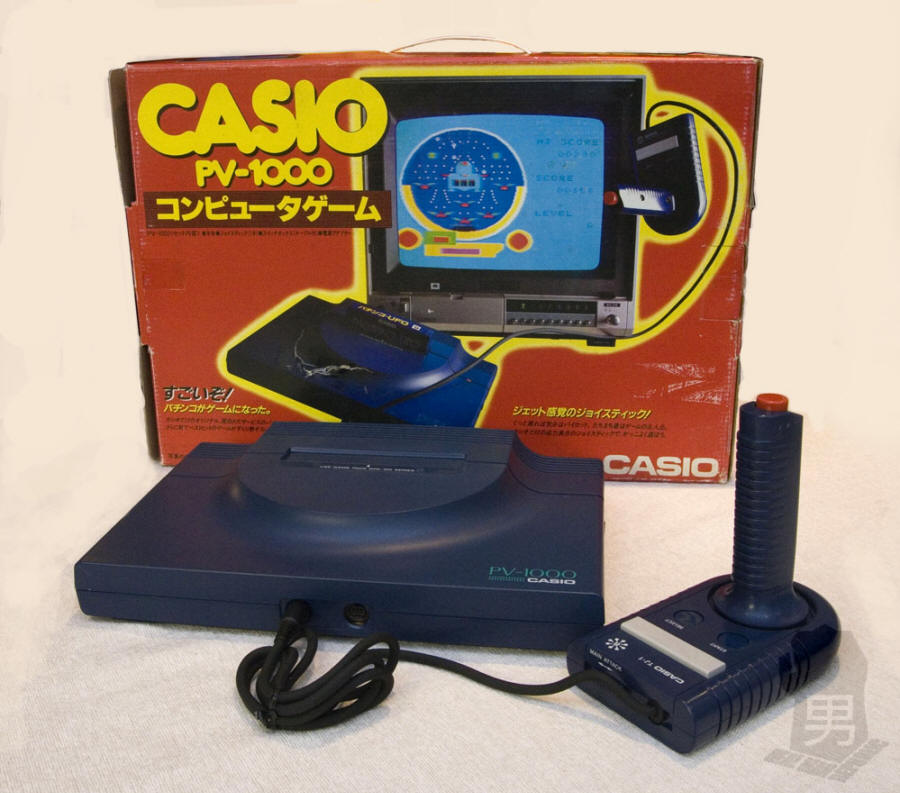
Casio PV-1000 console

(Picture and more info at: http://www.videogameconsolelibrary.com/pg80-pv1000.htm)

I once had the chance to buy a game cart for the PV-1000 for relatively cheap. But I didn't, because I don't think I'd be able to sell it for a decent price. Who would buy it? I have never seen the PV-1000 console for sale in Japan, though I once read a forum post from someone who found his on eBay.

PV-1000 was released by Casio in Japan in October 1983, a couple months after the Famicom and the Master System. Its retail price was the same as the two others: 14,800 yen.

However, the PV-1000 was a worse machine and it was pulled off the shelves without hardly anyone caring. The Famicom became very popular very fast, largely thanks to all the killer games from Nintendo. And this was even 1,5 years before Super Mario Bros was released. It can be difficult to imagine how the famicom could become popular with all those primitive games such as Donkey Kong, and the best seller: Baseball (true!). But it was the best there was.

Anyways, I do like obscure stuff but only if they either look nice or are interesting to play. Games that are just bad aren't that interesting.

A system sure is obscure if you can't find it on gamefaqs. The system did however have 15 games, according to Wikipedia. According to my theory, that might indicate that 5 are common, 5 are uncommon, and 5 are rare. But that is just an estimate. In any case, all games for it are really hard to find.

This is a video of Super Cobra on the PV-1000, from a guy who modified his console to give out composite signal.When I see games like this I just think: "so primitive... how can you enjoy this?"

But did you know that the first Famicom games were only 16 KB? I don't know when that changed exactly but in the beginning famicom games looked primitive for space reasons. Still, Super Cobra looks worse than any famicom game.